
Geologist -
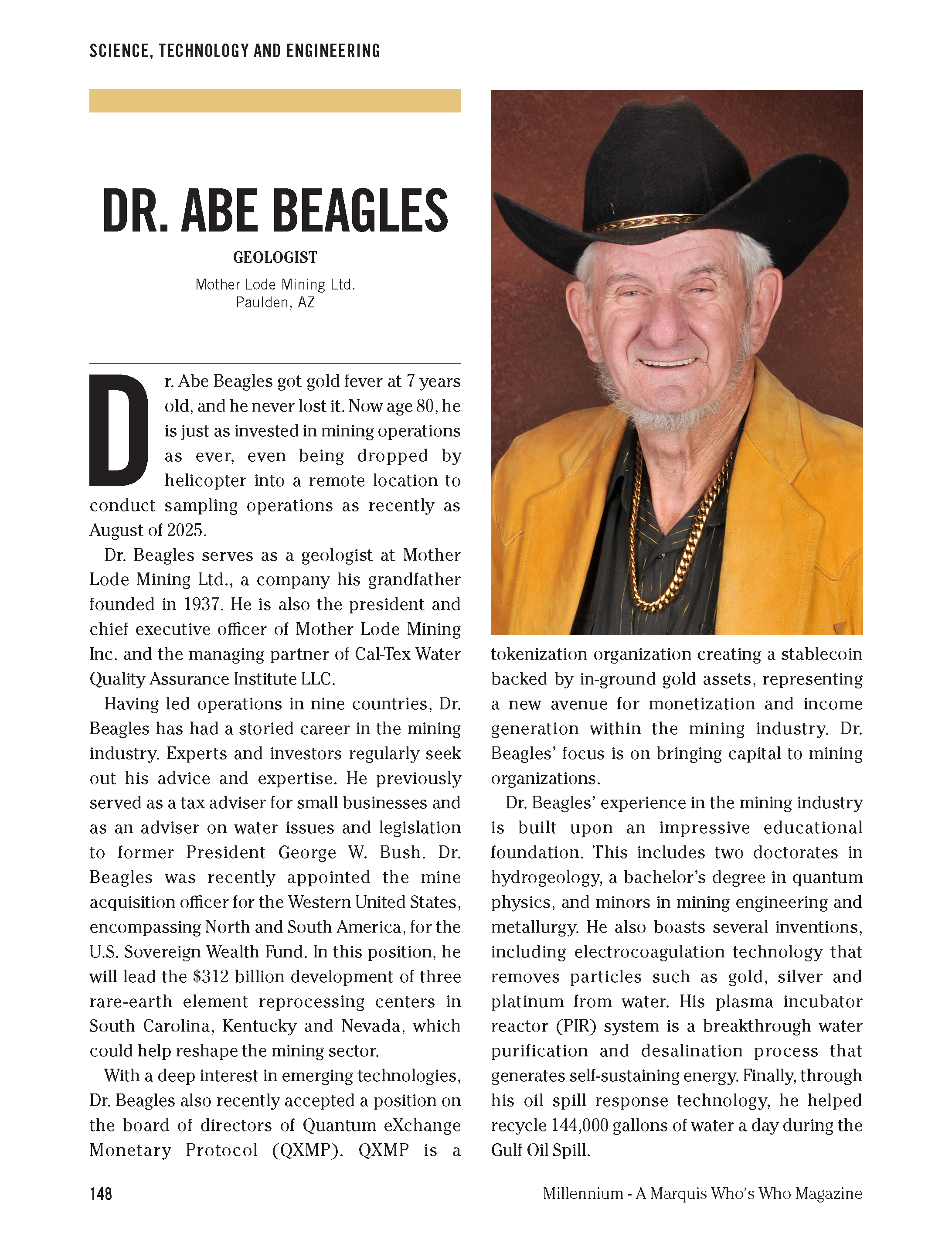
Dr. Abe Beagles
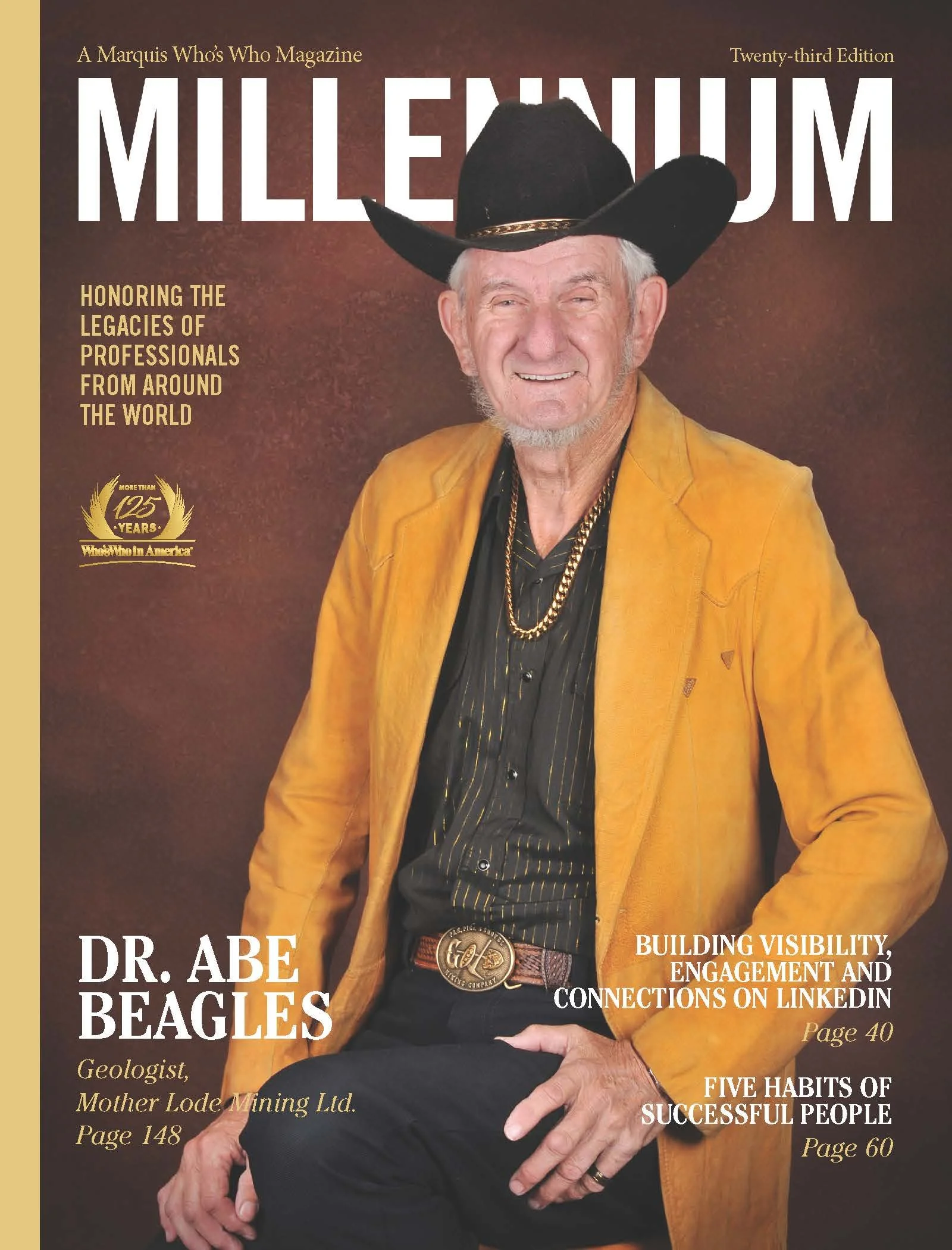
Our team of experienced geologists is dedicated to providing top-notch services tailored to the mining and funding sectors. With a track record of excellence and expertise, we strive to deliver exceptional results for our clients.
Let us handle all your geological needs with precision and professionalism. Our commitment to quality and accuracy sets us apart in the industry, making us the preferred choice for all your geology-related requirements.
Our clients benefit from our decades of experience and trusted relationships with laboratories, financial institutions and other sectors.
Partner with us for a seamless experience and reliable solutions that meet the highest standards of the geology sector.
Plasma Incubator Reactor System
Inventor - Dr. Abe Beagles
Seasoned geologist with extensive expertise in placer and hard‑rock mining, NI 43‑101 technical reporting, and project development. Over five decades of global experience—including Australia, Alaska, California, Honduras, Mali, and Arizona—delivering high‑value mining operations, joint ventures, and innovative extraction technologies. Renowned for leading complex projects from concept to execution, securing funding, and maximizing resource recovery.
Core Competencies
• NI 43‑101 Geological Reporting
• Placer & Hard‑Rock Mining Operations
• Project Design & Execution
• Asset & Equipment Funding
• Joint Venture Formation
• Advanced Mineral Recovery Technologies
• Cost & Resource Management
• Environmental Compliance & Feasibility Analysis
Professional Experience
Independent Consultant (1968–present)
• Queensland, Australia (1968–~1972)
Developed and financed a river-based mining operation involving a 12″ dredge on a 40' × 60' barge, with bank-based recovery systems. Project cost: USD 356,786; recoveries totaled USD 3,510,678 in noble metals.
• Moose Creek, Alaska (1970–1985)
Scaled mining operations across 600+ acres, enhancing throughput from 40 to over 400 yards/hour. Acquired and deployed a Klondike 400 plant for approx. USD 215,700. Project costs exceeded USD 4.15 million; sustained multi‑year production.
• Caribou River, Alaska (–1988)
Established a movable jet‑dredge system (8") on skids, servicing expansive gravel bars on 1,600 acres. Initial setup cost: USD 3.7 million; total production exceeded USD 17 million.
• Honduras (Phase 2)
Authored NI 43‑101 geologic report instrumental in securing project funding. Constructed 47 miles of access roads at ~$140,000/mile (approx. USD 6.58 million), plus equipment costs of USD 2.67 million. Generated over USD 30 million in revenue over eight years.
• Horseshoe Bar, Merced River, California (1984–1985)
Prepared NI 43‑101 report to secure lending for river dredging operation. Deployed seven dredges across a 75′ river span. Startup cost: USD 245,000. 1984: Recovered 944 oz of gold; 1985: 867 oz.
• Browns Valley, California (1986–)
Spearheaded NI 43‑101 reporting for a joint venture. Financing total exceeded USD 7 million; equipment investment over USD 2 million. Cumulative revenue output: > USD 4 million.
• Harvard Mine, Jamestown, California (1973–1994)
Conducted NI 43‑101 report and a USD 3.2M environmental impact study; oversaw a 3‑year drilling campaign costing over USD 3M. Total investment: approx. USD 23M; employed 289 staff; payrolls exceeded USD 70M annually. Generated billions in lifetime revenue.
• Arizona Mines (2019)
Produced two NI 43‑101 reports and licensed proprietary Plasma Extractor System (PES) for USD 125,000 each. Retains 25% share of Noble Metals & Rare Earth Element recovery. Engineered cutting-edge pulverization and recovery systems.
• Mali, West Africa (2019)
Performed NI 43‑101 report on 50,000 acres of premier placer gold terrain (up to 3 oz/yd²). Initiated joint venture with Mother Lode Mining, Ltd.; in process of mobilizing equipment and PES tech for operations.
• Congressional Order of Merit (2006) – Humanitarian and environmental work after the Indian Ocean Tsunami
• Ronald Reagan Gold Medal Award (2004 & 2005) – Environmental contributions in California
• Businessman of the Year Award (2003)
Awards & Recognition
Education & Training
• Bachelor of Science in Quantum Physics, Uppsala University, Sweden (1987)
• Minor in Mining Engineering, Hamburg University, Germany (1974)
• Doctorate in Hydrogeology & Platinum Refining, School of Mining, Geology and Geotechnology, Soviet Union (1973)
• Doctorate in Hydrogeology with Minor in Metallurgy, Kama Academy (1973)
Technical Proficiencies & Equipment
• NI 43‑101 Report Generation
• Multi‑scale Dredging & Wash Plant Systems
• Tailings & Placer Gold Extraction Technologies
• Plasma Extractor System (PES) Design & Licensing
• Infrastructure Development (Roads, Site Prep, Drilling)
• Environmental Impact Assessments & Compliance Reporting
Selected Projects at a Glance
Project Location Period Project Type Cost Outcome / Revenue
Queensland, Australia 1968–~1972 River mining with 12″ dredge $356,786 $3.51M noble metals
Moose Creek, Alaska 1970–1985 Placer mining w/ Klondike plant $4.15M+ Multi‑year production
Caribou River, Alaska –1988 Movable gravel system $3.7M $17M+ return
Honduras Phase 2 Road & site development $9.25M+ $30M+ revenues over 8 years
Merced River, CA 1984–1985 River dredging (multi‑dredge) $245,000 ~1,800 oz gold
Browns Valley, CA 1986– JV gold mining $9M+ $4M+ generated
Harvard Mine, CA 1973–1994 Hard rock mining & development $23M+ $70M+ payroll; billions revenue
Arizona (PES) 2019 Licensing & tech deployment $250K Ongoing recovery shares
Mali, West Africa 2019 Placer land assessment & JV N/A JV formation; funding in progress
Professional Profiles & Links
• LinkedIn: https://www.linkedin.com/in/dr-abe-beagles-6143b47
Leadership Roles
• Managing Member, Cal-Tex Water Quality Assurance Institute, LLC
• Director of Research & Technology Development, Cal-Neva Water Quality Research Institute (Non-Profit, California)
Innovations & Technologies
• Electrocoagulation Technology (25+ years R&D): Removes isotopic and colloidal particles (Gold, Silver, Platinum) from water; applied in geothermal, coal ash ponds, mining concentrates, and oil spill remediation. Achieved >99% removal efficiency of metals and biological contaminants.
• Plasma Incubator Reactor (PIR) System: Breakthrough water purification & desalination process producing hydrogen and oxygen by-products, generating self-sustaining electricity. Joint Venture with Jetstream Wind, Inc. (2009) for applications in New Mexico and Niger Delta, Africa.
• Oil Spill Response Technologies: Deployed EC and centrifugal systems (100–500k GPD) for oil-water separation and hydrocarbon remediation during Gulf Oil Spill.
Entrepreneurship & Business Development
• Founder of Cal-Tex Water Quality Assurance Institute, LLC and Cal-Neva Water Quality Research Institute.
• Negotiated joint ventures for global water purification, including Africa (Niger Delta).
• Collaborated with Devon Energy in Barnett Shale, TX on water recycling and purification technology commercialization.
Contract Geologist Engagements
• Rio Tinto
• Barrick Mining Corporation
• Kinross Gold Corporation
• IAMGOLD Corporation
• Gold Corp
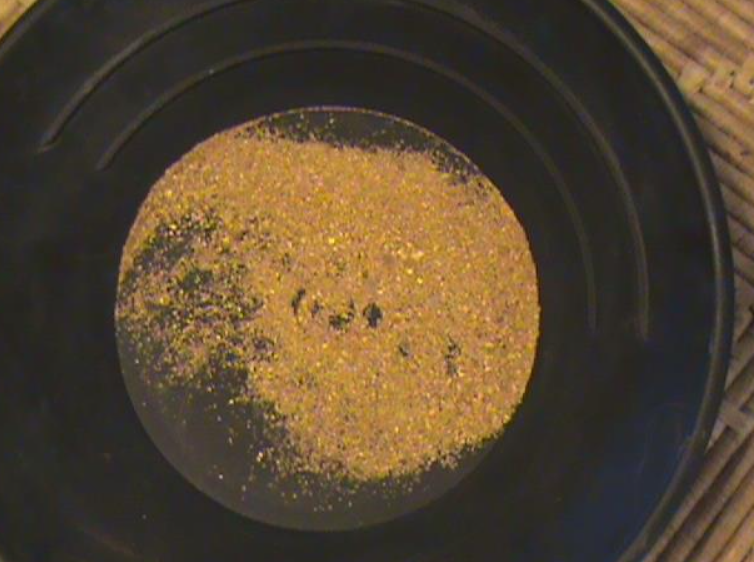
Chronological History:
Geological Services and Mining Operations
1. The first operation that I put together was in 1968, this was before I was a geologist, the site was the Queensland area of Australia where we had claims on a major river in that area. The total project cost for this operation was $356,786.00. It involved a 12 inch dredge, situated on a barge that was 40’ by 60’ and recovery equipment located on the bank of the river. This operation went on for 4 years and produced a total of $3,510 678.00 in recoverable noble metals.
2. Next was Moose Creek in Alaska where we had over 600 acres in claims along the creek. I took on the expansion of this in 1970 where we were doing an average of 40 yards per hour to over 400 yards per hour. I found a Klondike 400 plant that was on two trailers and had all of the support equipment needed to feed it. This was purchased with gold for a price of $215,700.00 The total project cost was a little over $4,150,000. It was moved to Alaska and placed on the claims where it still sits today. It quit operating in 1985 after it had produced mountains of gold and silver.
3. Next was a property located on the Caribou River in Alaska where MLM owned 1,600 acres of claims along the river. We needed a plant that could handle up to 200 yards an hour of gravel. There were multiple sand and gravel bars along the river to mine. We found an 8 inch jet dredge and sit the recovery equipment on the land and this was mounted on skids so that it could be moved from bar to bar. The total sit up costs of this project was $3,700,560. This operation ceased in 1988 after it had produced over $17,000,000.
4. Honduras was our next site of operations high in the mountains where an old associate of my family had claims. I did a Phase 2 NI 43-101 Geologic Report on the property which was used to get the necessary funding for the project. A JV was put together and equipment was found that could be advanced to the country, the mine site required the building of 47 miles of road through the jungles. Each mile of this road when it was completed cost the company over $140,000 per mile. The equipment cost was an additional $2,670,000. It produced over $30,000,000 in an 8 year period.
5. In 1984 a property was made available to us by a friend of mine who owned claims on the Merced river at a place called Horseshoe Bar. This had placer and hard rock claims on it and it required me to write a NI 43-101 Geologic Report on the project which was used by the Lender to negotiate a loan with us for our necessary working capital and the equipment leasing package they offered. This was a river dredging operation that would involve no less 7 dredges operation on a 75’ wide stretch of river where no one had ever dredged before. We used a 12” sub-surface dredge in the middle of the river and on either side was two 10” sub-surface dredges flanked by two Keene 8” surface dredges and finally two 6” Keene surface dredges. We employed a twin line marine dredge with a rock rake that removed all rocks over 8 inches. That year during the dredging season we worked one hundred feet of river bed from bank to bank and we recovered 944 ounces of gold. There were 11 men involved and the cost to put the operation together was $245,000. The next year we returned and took another 867 ounces of gold from the river. We completed the operation in 1985.
6. In 1986, a property was joint ventured in a place called Browns Valley in California. It was an old river bed that had been raised to the top of a mountain by the uplift which created the Sierra Mountain Range. In order to get the financing the JV partners demanded that I do a NI 43-101 Geologic Report on the entire project. This operation cost a little over $7,000,000 to put together. It involved a Klondike 300 wash plant that was acquired for $565,000. The other equipment brought the total cost to over $2,000,000. This property produced more that $4,000,000 in revenues over its life.
7. In 1973, the family found a property in California that had the potential to produce large amounts of gold. The families decision was based on a National Instrument 43-101 Geologic Report that I had done for the owner of the property the year before. The environmental impact study cost $3.2 million dollars, the drilling program took 3 years to complete and cost more than $3,000,000. This would prove to be one of the best properties and mining operation that the family ever mined. The total project cost was a whopping $23,000,000 when all machinery and equipment was in place. It employed 289 men and produced over $70,000,000 in payrolls per year to the county. It operated until 1994 when expansion plans were continuously rejected by the county because there was more ore available south of Hwy 88 but because two housing developers objected to the expansion of the mine into that area and later it was found that they were bribing the county officials not to give further permits to the operation, that my grandfather shut down the entire operation and closed the mine for good. This was the Harvard Mine in Jamestown California. It produce billions in revenue over its life time. There is still gold left in the tailings piles that formed the new mountain. The hole in the ground was ¾ of a mile lone by almost ½ mile wide and 1427 feet deep. Today the water contains enough gold to make it profitable to sit an extraction unit up and just mine the water.
8. In 2019, I was contracted to do two National Instruments 43-101 Geological Reports on two mines in Arizona. After these were completed I offered one of my three gold recovery technologies to these and both of them have signed my Licensing Agreement for $125,000 each. This technology is called the Plasma Extractor System and recovers from 3 to 15 times the assayed value of the ore because we recover the Monoatomic and the Colloidal Gold that encapsulates each piece of black sand in an ore. I also receive 25% of all of the Noble Metals and the Rare Earth Elements (REE) that is in the ore. I have also engineered the complete recovery system for both of these mines and this equipment is a few of the most advanced pulverization technologies that exist today and some of the most advanced gold, silver and platinum group metals recovery equipment.
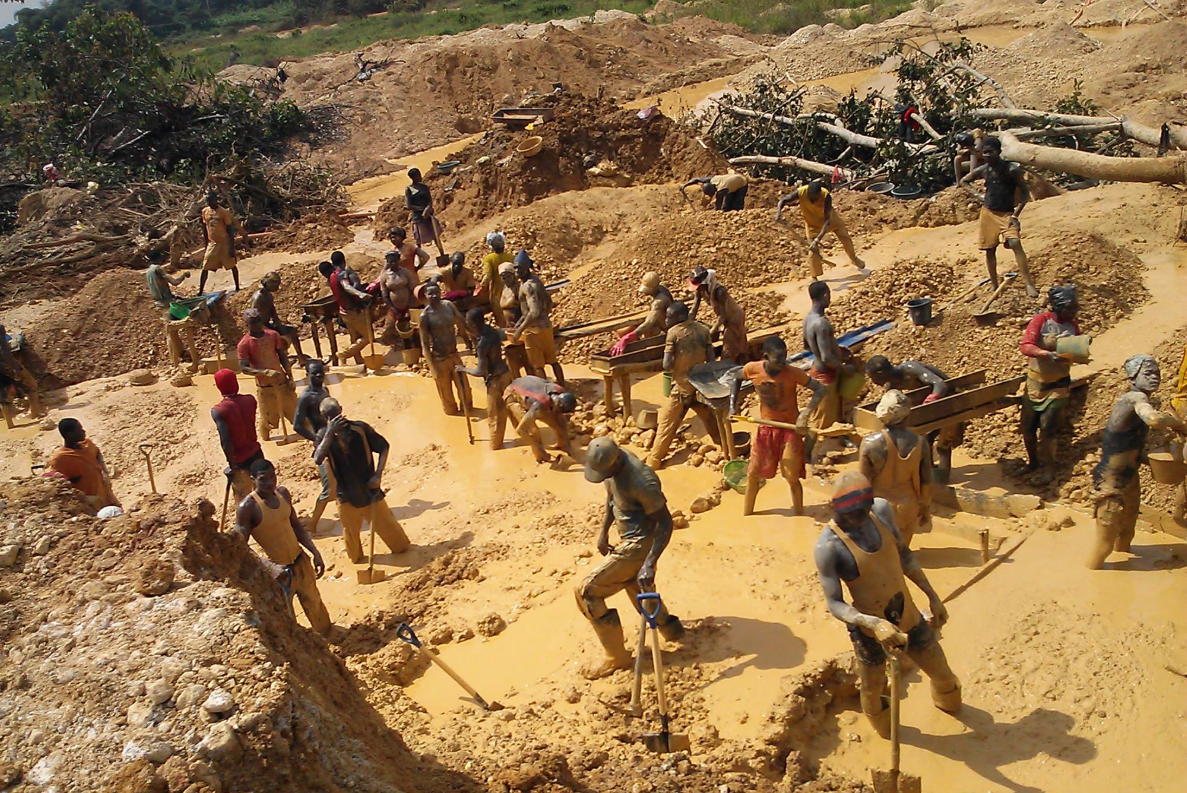
9. In 2019, I visited Mali West Africa and did a NI 43-101 Report on some 50,000 acres of placer gold land owner by one man. This is some of the richest placer ground that I have ever had the privilege of working on for it contains up to 3 ounces of gold in certain parts of the ground. A river runs through the entire 50,000 acres and makes dredging a dream work. The owner of the ground formed a Joint Venture with the Mother Lode Mining, Ltd. Company and funds are now being raised for a full blown mining operation to be conducted in 5 separate locations on this land as well as three Keene dredges working in the river. I will use my PES technology on the concentrates in order to increase the recovery of the Colloidal gold that exists here.